The Unfinished Rake
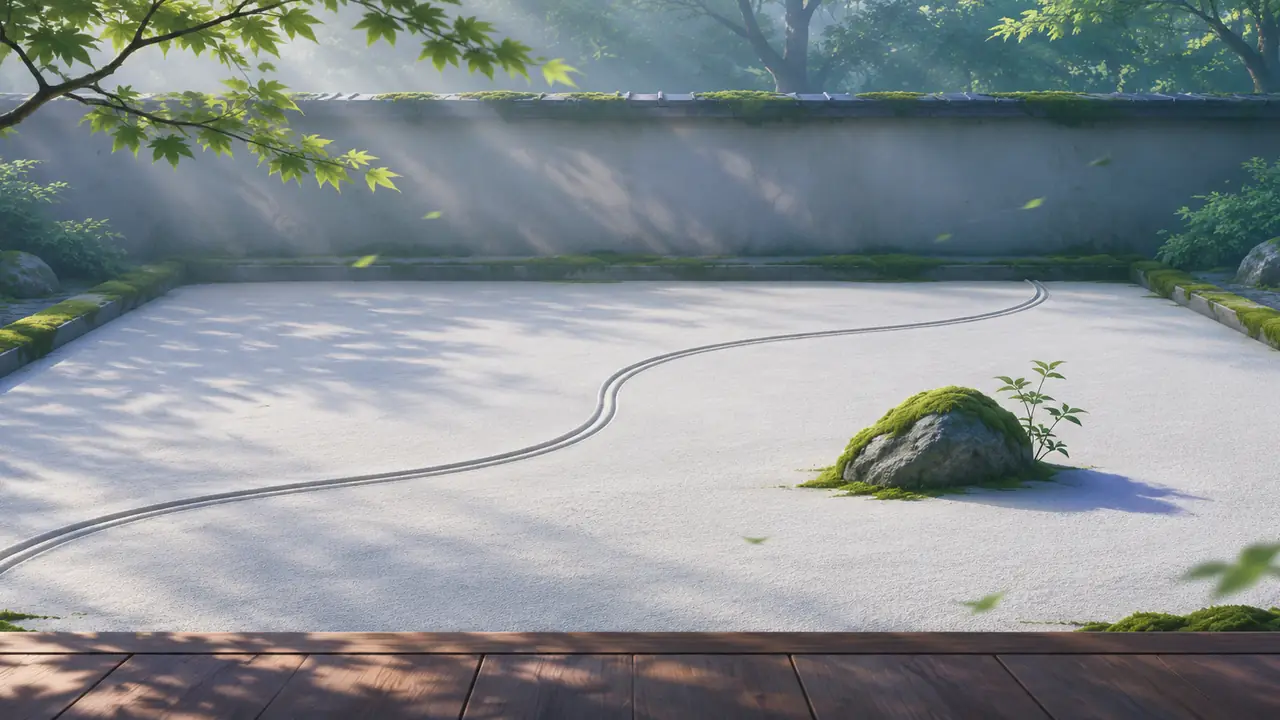
The Unfinished Rake starts beside a shallow sand bed. A board holds the near edge and a mossy stone interrupts the far one. The gardener can draw one groove toward the stone. There is enough room to continue past it. Stopping sooner leaves a region where drifting sand can reveal something about the wind. The first puzzle asks where a line should end so that a later movement is still possible to read.
Draw one groove with a visible end
The rake starts on the edge closest to the wooden plank and can be guided toward the stone. A shallow groove leaves the surrounding sand fairly level. A deeper one shows a small side where grains can collect. Neither has to cross the whole garden. The player can stop before reaching the corner, and the tail of the mark remains visible until they choose to do more work.
The basic loop is to inspect the bed, draw a short line, wait at a stable position and look at what happened to the untouched surface by the line. A faint drift can gather near the end. It runs in a slightly different direction from the rake. If you draw again immediately, the additional mark may cover the new trace. Waiting on the edge of the bed keeps its relation to the first groove clear.
Keep a quiet difference between the two marks
The sand uses several values of pale gray rather than a very bright white surface. Olive and green patches stay close to the stone and the edge of the garden. A blue cast shadow gives a stable beginning to the wooden board. The work asks a player to read a narrow difference where the grains have moved. We reserve strong color for the outer boundaries so it doesn’t compete with the sand.
A soft sound at the end of the rake motion makes the rest after it more noticeable. While the gardener pauses, there can be a faint wind sound from one side. The visible drift gives a similar cue when sound is off. A small movement in the grass above the bed provides a second way to check the direction without making either one a marker for the correct result.
Use the observation as a reason for the next line
After a little time, the edge of the drift can reach a region beside the lower stone. The gardener can change the direction of the next groove to meet that edge, or inspect it from a lower position. If a broad new mark would hide what they are trying to read, the player can leave it until they want to compare the other side. That gives the unfinished part of the bed a role throughout the puzzle.
The concept is in prototype development. One Groove records a useful first stroke. Wait for the Drift follows a pause with the original mark still in sight. The groove study links this scene to another use of openness at the gate.